Western Trips

Showing posts with label Indian Wars. Show all posts

Friday, May 24, 2013

State Parks in Texas


Fort Richardson post hospital building

Western Trips had the opportunity of visiting one of the more interesting state parks in Texas. Many of Texas' state parks are historic sites and our visit of Fort Richardson in Jacksboro Texas, not far northwest of Fort Worth, gave us a good glimpse of frontier military life. It was designated a National Historic Landmark in 1963. This is a stop you want to add to your Texas vacation planner if you're in the Fort Worth area. It's an excellent fun and educational venue great for the entire family.

Fort Richardson is located in Jacksboro Texas, 60 miles from Fort Worth and 60 miles from Wichita Falls on U.S. Hwy 281/380.

Fort Richardson State Park and Historic Site

Fort Richardson State Park and Historic Site are the remains of a federal fort built after the end of the Civil War. The state park includes 454 acres.

Fort Richardson hospital ward
Established in 1867 by the Fourth Cavalry, Fort Richardson was tasked with both enforcing reconstruction laws in north Texas and also with protecting settlers from Indian raids. The fort was the northern most of a line of federal forts in Texas constructed after the Civil War.

Indians raids were a decades long problem for settlers in Texas and wouldn't end until about 1875.The Comanche and Kiowa tribes were the raiding parties. Fort Richardson was built at a strategic location where the North Texas Prairies meet the Panhandle Plains. The location is also not far south of the old Indian Territory being about 120 miles south of Fort Sill. Native Americans who resided in Indian Territory would often ride south and raid settlers across the Red River in north Texas.The raiding was often and deadly. The army was forced to set up several forts, including nearby Fort Griffin and Fort Belknap, to curtail the north Texas attacks.

The Units Serving at Fort Richardson

During the fort's lifespan, several army and cavalry units were stationed there. From 1868 to 1871 it was the regimental headquarters for the Sixth Cavalry. From 1871 to 1873 it was the Fourth Cavalry, from 1873 to 1876 it was the Eleventh Infantry. Other units who served at Fort Richardson included the Tenth Cavalry and the Twenty-fourth Infantry.

Old post morgue
It's interesting to note the range of duties tasked to the army units serving at Fort Richardson. These included escorting wagon trains, helping local law enforcement to catch fugitives, protecting cattle herds and even overseeing elections. In general, the troops and officers at Fort Richardson and the surrounding forts helped settle north Texas in a variety of ways. 

The End of the Red River War

It took the Red River War during 1874 and 1875 to finally put an end to the Indian threat. Expeditions from Fort Richardson arrested Indians responsible for the Warren Wagon Train Massacre in 1871 and fought Comanches in Palo Duro Canyon in 1874. An interesting fact is that Gen. William Tecumseh Sherman was actually at Fort Richardson on an inspection tour when word of the wagon train massacre just about twenty miles to the northwest reached the fort. General Sherman was the head of the army during the President Grant administration.

Another interesting historic note is that General Sherman personally arrested the suspects in the Warren Wagon Train Massacre later at Fort Sill and had them sent back to Jacksboro Texas for trial. Incidents like the wagon train massacre is what reportedly caused Sherman to give his officers the order to go all out and bring all Native Americans to the reservation. The Red River War was the result of his orders.

Treatment room
Due much to the success of the Red River War and the end of Indian raiding the fort closed in 1878.

Fort Richardson was named after General Israel B. Richardson who had served in the Texas military during the Mexican American War before joining the Union Army during the Civil War. When the Civil War broke out Richardson had retired from the army and had been farming in Michigan. After the engagement at Fort Sumter that started the war Richardson re-enlisted.

Links to additional Western Trips articles you'll enjoy include: 

The Old Ranch Town of Matador Texas

The Western Army / Fort Reno 

Lockhart / History and the Barbecue Capital of Texas 

Tour the Historic Homes of Waco Texas


The Post Hospital

What you'll see today of Fort Richardson are two replica barracks and seven original structures including the hospital, morgue and bakery. The Visitor Center and Interpretive Center are in the old officer's barracks. The park offers guided tours daily.

Officers Quarters
You'll see a restored military hospital, the main exhibitwhich is one of the surviving buildings. The structure was built of sandstone and has been expertly restored. Inside you can see the Dr's office, the hospital kitchen, general ward and other rooms all restored to their original arrangement.These are excellent exhibits and will give you a good feel for the old remote life on the Texas frontier.

State Park Facilites

Like many state parks in Texas, Fort Richardson offers hiking trails, camping facilities and picnic areas plus a picnic pavilion for groups. One trail is 1.7 miles in length for hiking and another is a 9.5 mile equestrian trail.

Fort Richardson is one of the most historic state parks in Texas, easy to reach from Dallas and Fort Worth and makes a fine addition to your Texas vacation planner.If your visiting the Dallas/Fort Worth area it fits in for a very good day trip adventure.

(Photos from author's collection)


View Larger Map

Tuesday, August 7, 2012

History of South Dakota / Battle of Slim Buttes


There's a remote part of South Dakota away from major roadways, but about 150 years ago was alive with action during the Sioux War of 1876. The area is filled with South Dakota history and is definitely worth a visit. If your western road trip happens to take you near the northwest corner of South Dakota, there is a monument that serves as a memorial to a battle that has somewhat faded from our historical memory.

The monument which stands about one mile west of Reva South Dakota on Hwy 20 is all about the Battle at Slim Buttes. As to the number of troops and Native Americans involved in this particular battle, the numbers aren't overwhelming. Nevertheless, the repercussions of the Battle at Slim Buttes were widespread in regards to the Sioux War of 1876.

The Weeks After the Little Bighorn Defeat

So much has been chronicled about the Battle of the Little Bighorn, including on this site, but the Battle of Slim Buttes was directly related to what happened to George Armstrong Custer and the Seventh Cavalry in June of 1876. The story of the army's response to Custer's defeat is often overshadowed by the debate over what exactly happened and who, if anyone, was to blame at the Little Bighorn including some of the investigations that ensued. The steps the army took immediately after Custer's defeat is an interesting story. The U.S. Army troops in the area of Slim Buttes in 1876 were there because of the shocking defeat of Custer's troops a few months earlier. They were there to end the Sioux War one way or the other.
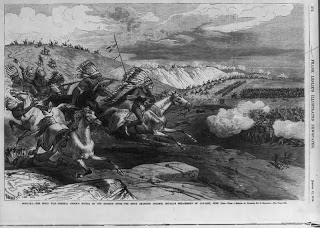
battle of the rosebud
Battle of the Rosebud
The three highest commanders responsible for the actions after the Little Bighorn were Generals Philip Sheridan, George Crook and Alfred Terry. While Sheridan was the head of the Department of the Missouri and headquartered in Chicago, Both Generals George Crook and Alfred Terry, under the command of Sheridan, were directly involved in the theater during the Little Bighorn Battle.

Crook was in command of a force moving up from the south as one of the three key columns trying to trap the hostiles along the Little Bighorn River.Without going into fine detail about the plan, which has been discussed in great length many times, Crook's troops were driven back south by the hostiles after the Battle of the Rosebud which took place on June 17th. As a result he never linked up with Terry's forces, which did include Custer. Crook's involvement in June 1876 was that he wasn't involved because he couldn't reach the rendezvous point. He finally camped his troops along the Goose Creek where his rear supply train would come to.

Chasing the Sioux

The Sioux bands started to move eastward as a large group during July and August of 1876. Crook's forces joined up with Terry's and started to move eastward as well. The goal of course was to catch up with the hostiles and either to defeat them and/or drive them back to the Indian agencies. There was also concern that more Sioux didn't leave the reservation and join their brothers. As a result, the army took over control of the reservations from the Indian Department. Any renegade Indians who did happen to show up at the agencies were immediately disarmed and had their ponied taken away.

general george crook statue
Statue of George Crook at Fort Omaha
What took place prior to the Battle of Slim Buttes, and is a big part of South Dakota history, after Crook separated from Terry's troops could only be called the most rigorous and nearly impossible long march in U.S. Army history.

What was to ensue over the following few weeks would try the most skilled soldier to the limits of human endurance. Both General Terry and General Crook reported directly to General Philip Sheridan who's headquarters were in Chicago.

The Hardest of Marches

Instead of leading his troops toward a supply depot on either the Yellowstone River or further east at Fort Lincoln, Crook became concerned for the safety of Deadwood in the Black Hills. This was about 180 miles south of his current position. Crook's concern was that Deadwood and other small mining camps around it would be attacked by the Sioux. As a result, he decided on a march to Deadwood while rations were almost exhausted. Much of what took place during this arduous march would be chronicled by the journalists who were embedded in his command. The excellent book, Slim Buttes, 1876 by author Jerome A. Greene gives a detailed description of the long march, the slaughtering of cavalry horses necessary to feed the troops and the accidental Battle of Slim Buttes that took place during this journey toward Deadwood.

general philip sheridan memorial
Statue of Gen. Philip Sheridan, Washington, DC
Some of the troops under Crook's command were decidedly against this change of plans. The troops were tired and had been marching through rain and hail storms and the thick mud they produced. They were well aware of the rations situation and were put on half rations due to this. Yet, some did want to engage the hostiles and the turn south to Deadwood seemed that they were giving up the chase.

 In other words, some felt that the entire march, as difficult as it was, was turning into a waste of time and energy. The supply situation went from bad to worse. More played out horses were slaughtered for food. Cavalry troops were forced to march with the infantry. Many questioned General Crook's decisions.

Captain Anson Mills

When the command was a few days ride out of Deadwood, Crook made the decision to send a detachment up ahead to Deadwood to both notify the town of their position and at the same time buy and bring supplies back to the camp where Crook decided to hold the troops for a while.The detachment sent to the Black Hills was commanded by Captain Anson Mills. Along with Mills was 150 select cavalrymen. Crook ordered that the detachment avoid conflict with the hostiles during their journey. The detachment was sent for supplies to aid the larger group and were not sent out as scouts. While Mill's detachment of 150 troops made their way toward the Black Hills one of their non soldier scouts spotted Indians with game piled on their horses. When Mills heard of this he surmised correctly that there was certain to be an Indian village somewhere in the vicinity.

Battle of Slim Buttes

At this point Captain Mills made the decision to locate the village. When they neared the area they dismounted. They wished to get closer and ascertain the size of the camp and didn't want noise from their mounts to give them away. When the village was located on the banks of the Moreau River which today is named Gap Creek, Mills and several others including their scouts approached on foot. They saw the village but could not figure out it's size. One thing the troops in Crook's command knew was that Custer's attack on the Little Bighorn without first knowing the size of the enemy camp was a contributing factor to his defeat. Everyone in Mill's detachment knew that this was a critical element and especially since their numbers were only 150. As for the Indians, they had no idea about Mills' detachment. They were well aware that Crook was in the general area but not that one of his detachments was anywhere nearby.

george crook headquarters
Crook's Headquarters, Whitewood, Dak Terr
After discussing the situation with his officers, Captain Anson Mills decided that a daybreak attack would take place the next morning. The army had embraced surprise dawn attacks as the preferred method. This went all the way back to the Civil War days. In this instance, Mills would attack with three columns. The right and left would be on foot. The center column would be mounted and would tear through the village, stampeding the Indian ponies and shooting at whatever they could. Mills had hoped that the attack would be over in one clean sweep. The Indians would be killed or captured and any provisions they could find would be sent to Crook's starved soldiers.

What transpired was a bit different. The problem was that many warriors were able to flee south and west of the village and fired at the troops from the rocks and buttes above their former camp. The swift victory that Captain Mills anticipated didn't materialize. What occurred was a standoff where Indians in the rocks took shots at troops rummaging through the lodges in the village below. There was also concern that some of the warriors who fled would bring in reinforcements from Indian camps that were nearby. If that occurred, Mills attack against an undetermined size Indian village could have the same end results as Custer's attack.

Crook to the Rescue

Captain Mills sent a courier back to General Crook's encampment further north. Fortunately Crook did not stay encamped as long as anticipated and was moving forward when the courier reached him announcing the Indian fight Mills' troops were involved in.

Crook and his troops set out in the direction of the village to reinforce Mills. Crook's command reached the Indian village, joined the fight and after a full day and the loss of several men took the village as well as some captives, mostly women and children who were hiding in the rocks above. The Battle of Slim Buttes took place on September 9 and 10, 1876, about 2 1/2 months after Custer's defeat.  Interestingly, while rummaging through and destroying the Indian lodges, Crook's troops discovered several items taken from Custer's command. Cavalry shirts, a Seventh Cavalry guidon and several other personal military effects were found.

The estimates of those killed in this battle were two cavalrymen and one civilian scout. After the battle ended and the dead were buried, Crook headed for Deadwood Dakota Territory where he would be welcomed along the way with supplies brought out by the citizenry. A courier had been sent to notify the town of Crook's nearby position. When the troops eventually made it to Deadwood they were greeted with a great ovation.

Significance of the Slim Buttes Battle

It's interesting to look back at the Battle of Slim Buttes. This was not a large scale decisive battle of the Sioux War but it was a significant battle and victory for several reasons. For one thing, it was the first military victory for the U.S. Army in the Sioux War. General Crook often thought of the Battle of the Rosebud as a victory but it was not. His advance was pushed back by the hostiles and if anything it was a draw of sorts. Custer's Little Bighorn defeat a week later was a disaster. It was important that the army have some type of victory and the Battle of Slim Buttes satisfied that. In fact, though the Battle of Slim Buttes came about by chance while Captain Mills was on another assignment, the results of the conflict did much to raise the army's morale.
surrender of crazy horse
Crazy Horse surrender, May 1877

There were battles after Slim Buttes in November and January of 1877. If anything, these battles and the fierce winter weather helped convince the renegades that continued fighting of the army was futile and the only realistic option for their survival was to return to the reservations. This of course would finally take place in 1877 with General Crook accepting a surrender of sorts from Crazy Horse and his followers. This surrender in May of 1877 was the end of the Sioux War that began in the summer of 1876.

You may be interested in the following related articles we've published. George Crook-Frontier Soldier,  the Death of Sitting Bull and the Ghost Dance Movement and a Steamboat and the Sioux War.

The Indian Wars in the west would however continue on and off for about another fourteen years. There were the Apache battles in the southwest and the Nez Perce War in the northwest. According to most historians, the Indian Wars ended in December 1890 with the death of Sitting Bull and the massacre at Wounded Knee. The year 1890 was also the official end of the American western frontier as stated by the Bureau of the Census.

Two additional books I would recommend are General George Crook: His Autobiography and A Terrible Glory: Custer and the Little Bighorn by author James Donovan.

(Article copyright Western Trips. Photos and images in the public domain)


View Larger Map

Thursday, September 1, 2011

Fort Apache

Fort Apache is located in eastern Arizona about 120 miles east of Phoenix. Many people may remember the highly popular 1948 film by the same name directed by John Ford and starring Henry Fonda and John Wayne. Fort Apache was one of the classic old west movies John Wayne starred in.

A Visit to Fort Apache

Fort Apache 1873

Today the site of Fort Apache is an Arizona State Historic Park located off Arizona State Hwy 73. It's a fun and educational stop during your Arizona vacation road trip and one of Arizona's finest historic landmarks. Today, the 288 acre site is comprised of 27 buildings dating between 1870 and 1930. Buildings include a guardhouse, officer quarters, stables and dormitories.

Also included is the White Mountain Apache Cultural Center and Museum. The museum features an exhibit about the legacy of Fort Apache and an exhibit "Footprints of the Apache". Many very interesting photos and artifacts make this a must see during your Arizona vacation. It's one of the most historic of Arizona State Parks and it's an ideal family road trip destination.

Early Days of Fort Apache Arizona

The story of Fort Apache begins in July, 1869, when Brevet Colonel John Green of the U.S. 1st Cavalry led an expedition of more than 120 troops into the White Mountains from Camp Goodwin and Camp Grant to the south. The mission was to kill or capture any Apache people they encountered. Green's expedition headed north up the San Carlos River, across the Black River, and to the White River in the vicinity of the future Fort Apache. The Apache Indians have lived in this region for centuries.

Green's scouts discovered over 100 acres of cornfields along the White River. Escapa - an Apache chief who was also called Miguel visited the  Army camp, and invited Colonel Green to visit his village. Green dispatched Captain John Barry, telling him "if possible to exterminate the whole village." When Barry arrived at Miguel's village  he found white flags "flying from every hut and from every prominent point," and "the men, women and children came out to meet them and went to work at once to cut corn for their horses, and showed such a spirit of delight at meeting them that the officers [said] if they had fired upon them they would have been guilty of cold-blooded murder."
Apaches 1873

Green returned a second time to the White Mountains in November 1869 and met with the Apache leaders Escapa (Miguel), Eskininla (Diablo), Pedro, and Eskiltesela. At that second encounter the Apache chiefs agreed to the creation of a military post and reservation. They directed Green to the area of the East and North Forks of the White River.

The Battle of Fort Apache occurred on September 1, 1881. It was an engagement between the cavalry of Fort Apache and dozens of mounted White Mountain Apache's. The attack on Fort Apache, commanded was a  reprisal for the Battle at Cibicue Creek in which a notorious medicine man had been killed along with a cavalry officer.

The Ft Apache battle lasted all day but the Apaches more or less stayed outside of the range of the cavalry riflemen. Reinforcements arrived a few days later but by that time the Apaches had scattered into hiding. Only three American soldiers were wounded and White Mountain Apache casualties were unknown. While the battle itself was not large in scope, it's repercussions were.

Aftermath of the Battle

After the battle other groups of Apaches left their newly formed reservations. They either escaped to northern Mexico or joined Geronimo and other Apache leaders in their war against the whites, both military and civilian. Geronimo remains a Native American legend much the same way as Sitting Bull and Crazy Horse. The two separate engagements at Cibecue Creek the year before and Fort Apache started another Apache War in Arizona Territory which would finally end with the surrender of Geronimo at Skeleton Canyon five years later in 1886. All in all, the Apache War lasted some 25 years.

The Larger Decades Long War

Officially, the first U.S. military engagements against the Apaches occurred as early as 1851. It officially ended with Geronimo's surrender in 1886. In the Arizona Territory itself the war is believed to have started with a bloody cavalry attack on an Apache camp during the Civil War.

During this decades long war there were several battles often attributed to entirely different reasons. Apache depredations against white settlers ignited most of the skirmishes. Indians would raid ranches killing it's residents and stealing it's cattle. There was also a stagecoach massacre near Wickenburg Arizona in 1871. Killed in this stagecoach attack was Frederick W. Loring a young promising writer from Boston. Prior to the stagecoach attack there was a degree of sympathy toward the Apaches from many easterners but this attack and Loring's death changed some minds.

There were even battles between various Apache tribes. In some instances a tribe would help the cavalry during it's campaign against it's perceived enemy. The overriding cause however for this and for all Indian Wars during the 1800's was the emigration of white settlers and the military into centuries old Indian lands. This war like all Indian Wars was a clash of cultures. The clashes even go back to the earliest days of Texas settlement in the mid 1800's involving the legendary Comanche leader Quanah Parker.

Fort Apache in Later Years


Geronimo, far right,and warriors
The post which had a few prior names was designated as Fort Apache in 1879. It remained in use for decades and was finally abandoned in 1922 after it's use declined.

After an act of Congress in January 1923 the site became the home of the Bureau of Indian Affairs’ Theodore Roosevelt Indian Boarding School. It was overseen by the Interior Department. The school's initial purpose was to serve Navajo children but by the 1930s the majority of students were Apache. In 1960 the Arizona State Department of Education opened a public school in nearby Whitewater and most of the students transferred there. The school continued to function as a multi-tribe institution. The Theodore Roosevelt School still operates today on the very spot as a middle school. It has operated since 1980 under the administration of a school board selected by the White Mountain Apache Tribal Council.

If you're deciding what to see in Arizona you may very well want to consider a visit to Fort Apache as part of your Arizona vacation trip planner. There's lots of Arizona history to see and it makes a great family vacation side trip.

Also, a very good companion trip to Fort Apache when in Arizona is the historic Hubbell Trading Post on the Navajo reservation in the northeast part of the state. The trading post continues in operation and features many fine authentic Navajo products.


(Article copyright Western Trips. Photos and images from the public domain)

Friday, July 8, 2011

A Trip To Skeleton Canyon New Mexico And Geronimo's Surrender

 Explore Historical Sites of the Southwest

If you are planning a trip to southern New Mexico or Arizona, you're passing through territory that was very active near the end of the Indian Wars.

 The scenery is beautiful as you might expect and the desert/mountain geography allows many good photo opportunities. A road trip to Skeleton Canyon is a good addition to your vacation planner. Interstate-10 runs just north of this location which makes it a good, convenient and historic low cost side trip. The area straddles the modern day New Mexico/Arizona border. Southwest of Skeleton Canyon is Douglas Arizona and further is historic Bisbee and Tombstone Arizona.

Chasing Geronimo

geronimo with rifle
When General George Crook pursued Indians he went by the principle of "it takes an Indian to catch an Indian". That method doesn't say a lot about the ability of his regular troops but I don't think he really meant it that way. Native Americans were children of that land and often times to pursue an Indian it always helped to see things through the Native's eyes. Nobody knew the southwest as well as an Apache Indian. The fact is documented that the U.S. Cavalry, especially during the last decade of the Indian Wars, employed Native American scouts during these type of search expeditions.

In the year 1886, Crooks target of pursuit was none other than Geronimo.

There were several photos taken of Geronimo. The one shown above was taken in 1887.

The Apache tribes were regarded quite differently than the plains Indians. The army learned that the plains tribes would engage them head on. In other words there was a battle ground such as at the Little Bighorn in Montana. The plains Indians engaged combat in the open as if defending ground. The Apaches on the other hand fought guerrilla style.

There were hit and run attacks and the Apaches engaged in combat when there was something of material value to gain. Attacking settlers to steal livestock and other property. More than not the settlers attacked were killed.

The Apache tribes were similar to the Comanches, being nomadic and very skilled warriors. History tells us that some Apaches were even part of Quanah Parker's several hundred strong Comanche assault at Adobe Walls in the Texas Panhandle back in 1864 involving Kit Carson. It took some time for the War Department to realize they were fighting a different kind of foe. Several publications point to the fact that General Philip Sheridan, shown below right, then the head of the Army in Washington, himself didn't fully understand the Apache Indians. Because of this he often issued orders that realistically couldn't be carried out.

Geronimo The War Leader

general philip sheratonThe facts are that Geronimo was a leader. He was not officially an Apache chief. Geronimo led the Apache struggle after Cochise began the uprising back in 1861 during the Civil War years.

Geronimo and several other leaders went off the reservation and raided civilians on both sides of the border with a campaign of murder and pillage. For instance, it was chronicled in Mexico that the Apaches would enter a town on the premise of peace. They would get drunk with the locals and maybe a day or two later would turn back and attack the same town. Supposedly this happened in many Mexico settlements.

The Dangerous Border Area

The atmosphere along the American side of the border in the early 1880's was that of outrage. Local newspapers demanded that the army do more to protect the towns. Because of this there were large groups of American civilians also hunting Geronimo and his group. The Mexican army itself was engaged in the pursuit on their side of the border but met with little success. The renegade Apaches held up in the canyons on the western side of the Sierra Madre range just south of the border. This was a rugged mountain range with peaks of 10,000 to 12,000 feet. If the Apaches were met by an overwhelming opposing force they would scatter into the canyons and be impossible to battle. The Mexican's could not penetrate this mountain stronghold and essentially gave up the chase.

After General Crook's 1883 expedition into Mexico he was given pointed suggestions by his superior, Gen. Philip Sheridan, commander of the army, to consider just pulling back and to simply provide protection to the American border towns. Sheridan thought this was the best tactic and it most likely was inspired by the cries of the press. In response, Crook asked to be relieved of his command. He told Sheridan that the past eight years of his command of the army in Arizona were the hardest years of his career. Sheridan obliged and turned over command to General Nelson Miles, pictured below left. Miles in later years would be known for his intervention in the Chicago Pullman Strike. He was also a veteran Indian fighter serving in the Sioux uprising immediately after the Battle of the Little Bighorn in Montana. He was a very well regarded officer.

In Comes General Nelson Miles

general nelson miles at skeleton canyon According to the 1920 book "The Truth About Geronimo" written by Britton Davis, there was quite a change after Nelson Miles assumed command. Davis contends that the farms of the peaceful Apaches had been protected by Crook's presence but that after Miles took over the Apaches were removed to San Carlos and their homes, farms and all fixed improvements were turned over to white settlers. Also under Miles watch there were trainloads of Apaches, not combatants, sent east to Florida.

An Offer To Surrender


In 1886, General Miles sent a Major Charles B. Gatewood, pictured below right, on a mission into Mexico to speak with Geronimo about surrendering. Charles Gatewood was a 1877 graduate of West Point and the son of a Confederate soldier. Upon his graduation he was assigned to the Army of the West. Gatewood was chosen by Miles because he had a relationship with Geronimo dating back when the renegade leader spent time around Fort Apache in the 1870's. Gatewood was also very familiar with the causes of the Apache outbreak and Miles felt he was just the emissary he needed.

Gatewood Travels Into Mexico

In 1886 Gatewood and his troops did travel to Mexico and did meet with Geronimo. The story of his meeting is a long one but essentially Gatewood met up with other army detachments that had been in Mexico for months occasionally skirmishing with the renegades. It was not through these sources but through two of Gatewood's Apache scouts that he finally determined where Geronimo and the one remaining Apache leader with him, Nachite, were camped. Geronimo agreed to meet with Gatewood but only if Gatewood came with only a few others...no troops.


major charles gatewood
Major Charles Gatewood
Geronimo was interested in what message Gen. Miles had sent. Gatewood reportedly got right to the point and told Geronimo that he had to surrender and he and the others would be sent to Florida. Gatewood told Geronimo that all of the Apaches had already been sent to Florida. Geronimo initially refused but the meeting continued for a few days. Nachite wanted to see his family in Florida and the prevailing story is that he convinced Geronimo to change his mind and agree to go north with Gatewood. The terms were agreed upon, most of which was for Gatewood to protect them during the journey from both the Mexican's and the United States Army already deployed in Mexico.

The Journey Back to New Mexico


The traveling party finally crossed the border near where New Mexico and Arizona meet Mexico.
There are many side stories connected both with Geronimo's surrender and with the trip up from Mexico.

Geronimo ultimately surrendered to General Nelson Miles on September 3, 1886  at which time Miles repeated the terms of the surrender. On September 8th Geronimo and others were put on a train to Florida.

Much to Geronimo's surprise the destination was not St. Augustine where the other Apaches were but to a prison at Fort Pickens in Pensacola. The decision to send him to prison must have come from Washington. No research material I've found mentions this in the agreement Geronimo made with Gatewood in Mexico.

The Apache families were ultimately put together and sent to Indian Territory (Oklahoma) via Alabama. Geronimo passed away on February 17, 1909 of pneumonia. His gravesite is at Fort Sill, Oklahoma. Reportedly, on his deathbed he confided to a family member that he regretted surrendering in 1886. Geronimo's name lives on in Native American history along side many others such as Sitting Bull, Crazy Horse, Cochise and Red Cloud. Geronimo's Fort Sill gravesite is shown below left.


geronimos grave at fort sill oklahoma
An interesting side note is that the U.S. military used the codeword "Geronimo" for the raid that killed Osama Bin Laden in 2011. Another interesting Western Trips story is the Buffalo Soldiers involvement in New Mexico.

If you would like to add the Geronimo Monument to your New Mexico vacation planner, directions are to take Route 80 south off Interstate-10 to Rodeo New Mexico. This is near Apache Arizona and southwest of Lordsburg New Mexico. A short drive southeast of the monument is the actual surrender site. The Google driving directions tool on this website can help with getting there. 

The photo below shows the surrender site.  You may also be interested in the Western Trips short story about George Armstrong Custer's Garryowen. 

Another quite interesting Western Trips article is the Cheyenne Campaign of 1868 and Custer's involvement in the Washita River Battle.

The websites below offer more information on New Mexico and Arizona vacation planning.


Southwest New Mexico Tourism

Arizona Travel and Tourism 


(Article copyright Western Trips. Photos and images in the public domain)

Wednesday, June 22, 2011

The 25 Year Long Apache War And What Many Believe Caused It


When traveling the Arizona highways there are more than a few reminders that this land was and is the home of the Apache Indians. Arizona today was once part of the New Mexico Territory and then the Arizona Territory before United States statehood.
apache indians


The Apache Indian Wars


There were many ways to start an Indian war in 1800's America. One way was to take land from the Native Americans and force them to live on reservations. Another way was to hunt the buffalo to near extinction thus taking away the most important source of their sustenance. Still another was to make a treaty and then break it. In the 1861 Arizona Territory a new way was found. That was to kidnap a chiefs family and hold it for ransom.

This story starts in 1861 when a Tonto Apache Indian party raided a ranch in far southern Arizona Territory. The raiders stole livestock and ended up kidnapping a twelve year old boy, a stepson of the rancher's Mexican wife.  The rancher told his story to the local military at nearby Fort Buchanan (the remains of which are pictured below right). The commander, a Colonel Morrison, ordered a Lieutenant George Bascom to take a large contingent of troops and locate the boy. It's thought that while the army (Morrison) wanted to make a concerted effort to find the boy and have the ranchers livestock returned, his main concerns were the raging Civil War back east. He may not have been involved as much as he should have been in the unfolding drama.

Lieutenant Bascom

A bit also needs to be said regarding Bascom's background and experience. A Kentuckian and recent graduate from West Point, he had just recently arrived in the Arizona Territory about three months prior. He was unfamiliar with the area and likewise unfamiliar with the Apaches. In other words, he was inexperienced on the ground. Likewise, the troopers assigned to accompany him were a new contingent of troops also inexperienced. Not a good combination to deal with a delicate kidnapping situation as future actions would reveal.

The Story Unfolds

Bascom was unable to locate the tribe or the boy.
Bascom's opinion however was that the raid and kidnapping was done by the Chiricahua Apaches which is what the rancher claimed.

His commander then ordered him to go after the Chiricahua's and do anything necessary to free the boy. That's a  fairly open order and alot of responsibility for a relatively new Lieutenant.

Bascom along with 54 troopers traveled to a location known as Apache Pass where a Butterfield Stage station was located. In fact, the two station attendants were familiar with Cochise who had a winter camp in the nearby rugged mountains. There Bascom sent word that he wanted to have a meeting with Cochise. Bascom and his men set up tents about a mile away from the stage station and awaited Cochise. Apparently Cochise, who had a reputation for honesty, was suspicious of the meeting and as a precaution took along several family members.
bascom hill site arizona

What happened next was probably not a good move by the army. When Cochise and his family arrived at the meeting site pictured to the left, Bascom arrested him. Cochise managed to escape from the troopers and in retaliation Bascom took captive five members of Cochise's family.


The Conflict with Cochise Grows


A short time later Cochise sent a message to Bascom pleading for the release of his family members. Lt. Bascom refused the request and simply sent word back to Cochise that his family would be released when he twelve year old boy was released. When Cochise received Bascom's reply, he went out with some braves and attacked and kidnapped three Americans. Cochise planned to trade the Americans for the release of his family. Bascom refused to negotiate with Cochise. Cochise was in a corner.


The situation just continued to escalate. Cochise, pictured to the right, decided to flee to nearby Sonora Mexico and on the way he killed the three American captives. Not a wise thing to do. This intensified the conflict.


apache wars
When Bascom came upon the remains of the murdered Americans he hung all five of Cochise's family members in retaliation. It's not entirely clear who exactly made that decision.

The moment Cochise learned of the killing of his family is commonly recognized as the start of the 25 year long Apache War. An interesting fact is that the Apaches from Arizona looked upon the Mexicans as there enemies, not the Americans. The antagonism toward the Mexicans was an offshoot of the years of Spanish rule. It was the Spaniards who originally explored the American southwest and it was the Spaniards who first changed the Apache way of life. This was the situation in the entire southwest, all the way from Texas to California.


Also see our Western Trips photo article on a Visit to Old Tucson

A Situation Out of Control


The act of the kidnappings and the escalation that followed went out of control. The killings of the kidnapped victims turned into a catastrophe that in all respects could have been avoided. When you consider what occurred, you almost have to ask if the higher authorities were involved or was the kidnapping of Cochise's family by Lt. Bascom a decision made by him alone. If it was a spur of the moment decision by an inexperienced young officer then the 25 year long Apache War may have been avoided.


apache chief geronimo
It should also be noted that the period from 1862 to 1886 when Geronimo (pictured left) finally surrendered was not the only period of conflict with the Apaches.

Skirmishes took place as far back as the 1840's and even after Geronimo's surrender there were small skirmishes up to about 1900. Most of the latter skirmishes resulted from the army trying to put wayward Apaches back on their reservation land.

Small fights also resulted between Apaches and miners and ranchers over suspected theft of livestock and property. The question really is would there have been conflicts with the Apaches regardless of the Bascom Affair? With settlers heading into the territory in large numbers there certainly would have been problems. Would the warfare go on as long as it did without the Bascom Affair? You be the judge. Nobody knows for certain.


Taking a vacation or short trip to Arizona is always enjoyable. The vistas are magnificent. Arizona is always near the top of any list with southwest travel ideas. The area where this story took place is in far southern Arizona. Cochise County is along the Mexican border southeast of Tucson. It's in the far southeastern corner of Arizona. The towns of Tombstone and Bisbee, AZ ( see our post on Bisbee on this site) are in Cochise County. The region is very arid, rocky and picturesque. It's an area that truly exemplifies the natural beauty of the southwestern United States.

Some Good Travel Stops


There are numerous historic areas in Cochise County. While I would say to visit as many as possible, I would recommend putting the following ones in your trip planner. The Cochise Hotel located in the ghost town of Cochise. Built in 1882 it served as a Wells Fargo station and a telegraph station. The Coronado National Memorial located 30 miles southwest of Bisbee. The San Bernardino Ranch ( now called Slaughter Ranch) near Douglas, AZ which is associated with early ranching in the Arizona Territory. Also the Fort Bowie National Historic Site which is located near Apache Pass.

(Article copyright Western Trips. Photos and images in the public domain)

APACHE INDIAN RESISTANCE-GERONIMO VIDEO 


Friday, March 18, 2011

Old Fort Parker And The Formation Of Texas

fort parker in texas

 An excellent Texas side trip is Old Fort Parker located about 100 miles south of Dallas, between the towns of Groesbeck and Mexia. One of the most incredible stories during pre republic Texas started right there in the year 1836.


fort parker state park in texasThe story begins with the extended Parker family relocating to Texas from Illinois in 1833. The inducement was the Mexicans offering free land to settlers. The Mexicans had a difficult time during their advance northward into Texas primarily because of the hostile Comanche Indians. The Comanches were formidable warriors and they essentially checked the Mexicans advance northward. They were probably the main reason the Mexicans went no further than south Texas. Offering free land to white settlers was a way to build a buffer against the Comanches and also a way to push the Indians northward. 


In the year 1833, the frontier line was in east central Texas. The Parker family built their fort which was a working farm near present day Groesbeck, TX. At that time this particular site was on the far western edge of the frontier line. To some, it was considered probably too far west meaning that the Indian threat was much greater. 

comanche leader quanah parkerThe tale of what happened in 1836 at old Fort Parker is the subject of several very good books. In short, in May of 1836 the Comanches approached the Parker settlement under the guise of asking for food. Several family members approached the Indians and were willing to offer some supplies. The brief meeting took a quick turn for the worse and several Parker family members were slaughtered. The Indians, as was common at the time, kidnapped the children. Cynthia Ann Parker, nine years old, was one of the captives and was held by the Comanches for decades. Indians took young white captives for two reasons. One was for their ransom value and the other simply to assimilate them to their ways and increase their own population. During this time Cynthia Ann Parker gave birth to half breed children one of which turned out to be the warrior chief named Quanah Parker ( picture to the left). Quanah grew up and roamed and raided white settlements on the plains for years and was probably considered the most famous and feared Comanche chief who fought with the military until his surrender in 1875. Interesting enough, Quanah eventually became a main proponent for the Indians adopting the white man's way of civilization and settled near Fort Sill, OK.


The story is fascinating and of course there are many side stories sprouting from these events during the mid 1800's. One of which is the story of Colonel Ranald Mackenzie who was considered one of the army's premier Indian fighters and was the person whose troops brought final defeat to Quanah's band. Other stories concern the origins of the famed Texas Rangers and attempts by groups of Texans to free the captives.


A visit to Old Fort Parker makes for an interesting side trip into the early formation of the Texas Republic. Nearby the fort is the Fort Parker State Park.


You will want to visit these web sites for additional information about Old Fort Parker and the Fort Parker State Park and their exact locations:


www.oldfortparker.org


www.tpwd.state.tx.us


Sunday, March 13, 2011

The Modoc War/ Northern California

modoc indian chief captain jack
modoc war cave in california lava bedspicture of general edward canbyThe Modoc Indians lived in far northeastern California in the area of the lava beds and Tule Lake. The lava beds are now a national monument and make an excellent side trip for anyone on vacation in far northern California. The lava beds are located in Siskyou and Modoc Counties. 


The Modocs whose leader was known by the name of "Captain Jack" were known as a relatively peaceful tribe of native Americans and as compared to their cousins on the plains did not really experience the full brunt of western expansion and the decades long Indian Wars.


Like most of the conflicts between Indians and settlers, the catalyst was the encroachment of white settlers onto traditional Indian land. The problems for the Modocs started in earnest in the early 1850's. Remember that the gold rush in 1849 brought thousands of settlers into California and the tide only grew larger with each passing year. In 1852 the Modocs killed 65 white settlers on a wagon train. Eventually the military becomes involved when settlers are slain and in retaliation 41 Modocs were killed at a supposed peace conference with a California militia. Hostilities continued until 1864 when the Modocs signed a treaty that had them relocate northward into southern Oregon so that their fertile land could be taken over by the white settlers. The relocation didn't work well because the Modocs were now encroaching on the Klamath tribes and there was violence that ended with murdered whites which then caused the Oregon settlers to set upon the Modocs.


The Modocs retreated back to the lava beds area and during a peace parley in April 1873 with the Civil War hero General Canby of the army, Captain Jack pulled out a gun and killed him. The army retaliated and captured Captain Jack and his small band in the lava beds which they fled to for natural protection and concealment. The end result was that he and three other Modocs were hanged for the killing of Canby and another man. The Modoc War is sometimes referred to as The Lava Beds War.

You will want to see our Western Trips article and photos of a trip to historic Oregon City, the end of the Oregon Trail.

(Photos and images from the public domain)


This website will give you much more information on the area and it's exact location:


www.nps.gov/labe/planyourvisit/directions.htm

This site will give you more on the Modoc's and the war:

www.mnsu.edu/emuseum

Saturday, February 19, 2011

Adobe Walls/ Texas Panhandle


The site referred to as Adobe Walls rests in the Texas Panhandle about 78 miles northeast of present day Amarillo.

 During the mid 1800's this was essentially inhabited by Indians, a combination of many tribes and bands including the Comanches, Kiowas, Apaches and others. A fort was established there in the 1840's but was later abandoned due to the hostile nature of the area.

Buffalo Hunters and Indians

As far as the plains Indians were concerned this was their prime buffalo hunting grounds. The buffalo was probably the most important thing for the plains Indians to survive because it supplied not only their prime food source but also buffalo hides that were used for clothing especially during the cold winters and coverings for their lodges. Buffalo horns were crafted into utensils such as plates. The buffalo was the staple resource for plains Indian survival.


The significance of Adobe Walls was that there were two battles that took place there. One was in 1865 that involved frontiersman Kit Carson and units of the army against several Indian tribes. The result was 3 army dead and 60 Indians killed or wounded. Kit Carson considered this battle one of the most close calls in his frontier career.

The second took place in 1874 and involved Indians ( led by Comanche chief and warrior Quanah Parker (which is an interesting story in itself)  against mostly white buffalo hunters. These buffalo hunters mostly from the Dodge City, KS area established a small settlement as a trading post. Dodge City was considered the main shipping out point for buffalo hides.


Sharps rifle model
The Sharps Rifle

The buffalo hunters employed powerful new long range Sharps Bison rifles that were so effective that a single hunter could kill upwards of 100 buffalo per day, sometime more. You can understand how this greatly depleted the massive buffalo herds in the matter of a few years and explains much of the hostility from the Indian hunters.

During the second battle the story goes that white defenders at Adobe Walls while hidden in their mostly sod structures were known to pick off an Indian from his horse a half mile away. This famous shot was attributed to defender Billy Dixon and his Sharps rifle. Needless to say this new weaponry startled the attacking Indians and the battle pretty much ended up a draw.

Tribes Regularly Roamed from Indian Territory


picture of kit carson
Kit Carson,  public domain
During these years many of the Indians were situated in Indian Territory ( this was the goal of the army) which was in present day Oklahoma specifically Fort Sill.

This did not prevent many bands from roaming off the reservation particularly during the summer hunting months. The two main reasons for this was the Indians natural desire to roam free and hunt for food. The second was that  food supplies promised from the government to reservation Indians was actually delivered spotty at best due to both logistical problems and outright fraud and theft.

Thus the Indians repeated incursions off the reservation for both hunting and raiding lonely white settlements. The  ineptness of the Indian agents just added fuel to the flames of Indian discontent with the white settlers. It was one thing not delivering on treaty promises and quite another depleting the buffalo at the same time.


There are no structures remaining today at the site of Adobe Walls but there are several monuments commemorating the historic events that occurred there that explain what occurred and even showing a list of the defenders at the time of the battles.The site is listed in the National Register and is a Texas State archeological landmark. You may find our Western Trips story of the famed XIT Ranch interesting. It existed very near the site of Adobe Walls in the Texas Panhandle.


The main east/west thoroughfare that comes closest to the site is Interstate 40. The site is located in Hutchinson County, TX, 78 miles northeast of Amarillo and 28 miles northeast of Borger, TX.


I think you will find this a worthwhile side trip into history for the whole family.

You may also enjoy the additional Western Trips articles below...

Kit Carson of Taos New Mexico

Historic Fort Reno Oklahoma


(Article copyright Western Trips)
br/>
View Larger Map