Amarillo Texas, the largest city in the
Texas Panhandle, owes it's early growth to both the cattle and the railroad industries. In addition to that, the city of Amarillo was on the highly popular old Route 66. Everything came together for Amarillo that translated to growth. The early cattle industry was all around Amarillo. This included the historic XIT Ranch which occupied over 3 million acres in the Panhandle as well as the JA Ranch, operated by
Charles Goodnight, the Father of the Texas Panhandle. Add to this the fact that Amarillo was once referred to as the "
Helium Capital of the World".
 |
| Paramount Theater Building, Amarillo Texas |
Some may not realize that the National Helium Reserve, established in 1925, is located about twelve miles northwest of Amarillo. This is our nation's strategic helium reserve that reportedly holds over one billion cubic meters of helium gas.
Amarillo and the Texas Panhandle were traversed by many years before the town was created. Coronado's 1540 Spanish Expedition of the southwest crossed the high plains. The Comanche Indians roamed the area. In the latter 1800's the massive 3 million acre XIT Ranch, owned mostly by British investors, established itself in the Texas Panhandle and in return built the Texas state capitol building in Austin. In addition to the
XIT, the latter 1800's saw the founding of Charles Goodnight's
JA Ranch centered around
Palo Duro Canyon, just to the southwest of present day Amarillo. Goodnight's home still exists in Goodnight Texas, a short drive east of Amarillo on US Hwy 287. The area where Amarillo sits today was at one time used by buffalo hunters for camping. The organization Amarillo, while being surrounded by ranches, was actually the result of the Fort Worth and Denver Railroad searching for a good watering spot. The site was chosen in 1887 and a year later was moved to the east on somewhat higher ground to reduce the threat of flooding. The history books name Henry B. Sanborn as the true "Father of Amarillo". Sanborn and his business partner, Joseph Glidden, bought up land in this area and lured other merchants there. The early business section was centered around Polk Street.
 |
| Amarillo's Polk Street mansions |
Today,
Polk Street is considered the entertainment section of old Amarillo. Today's Amarillo tourist can view beautiful mansions built by early merchants and professionals. The
Bivens Mansion now houses the Amarillo Chamber of Commerce. Polk Street is also home to the historic
Paramount Theater. Built in 1932, the Paramount Theater was the premiere theater in Amarillo. The theaters popularity lasted for decades until the 1970's when more modern cinemas were built and went out of the moving screening business during that decade. Eventually the Paramount structure was totally renovated and put to use as an office building.
Route 66 ran through Amarillo on
Amarillo Blvd. Just as with many towns and cities where the old Mother Road traversed, the district today is alive and well. Most of today's Route 66 activity can be found on Amarillo Blvd and
Sixth Avenue between Georgia and Western Streets. Antique shops and other interesting stores are found all along this mile long stretch and the Route 66 area is also home to many events during the year including the always fun classic car shows. When the highway system was laid out, mostly during the 1920's, Amarillo was fortunate to be located at a point where many highways intersected. Three major roads plus Route 66 all merged at Amarillo. US Hwy 287 is the main artery leading from the Dallas/Fort Worth area to the Texas Panhandle.
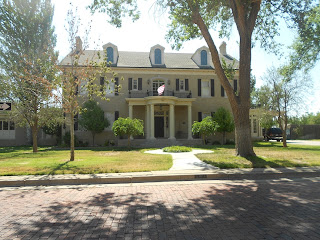 |
| South Polk Street in Amarillo |
Amarillo's economy today still has a lot to do with ranching and oil but also is in the middle of modern twenty first century industries. Early Amarillo had a lot to do with the railroads and shipping and today's modern Amarillo still does. The
BNSF Railroad maintains a large yard in the city with freight trains. Trains from the east come from Oklahoma City and up from Fort Worth Texas. A good deal of the train traffic from the west are rail cars hauling coal from the Colorado and Wyoming mines. Amarillo's modern economy is made up of a combination of industries. If you're looking for things to do and see during your Amarillo trip, there are quite a few. Listed below are only a handful of side trips available.
Following are links to our articles regarding more historic side trips close to Amarillo... the
Charles Goodnight Home in Goodnight Texas, the
Armstrong County Museum in Claude Texas and a visit to beautiful
Palo Duro Canyon. Another interesting stop east of Amarillo near the Oklahoma / Texas border is the singer / songwriter
Roger Miller Museum in Erick Oklahoma right on old Route 66.
For the western road trip traveler flying by Amarillo on Interstate 40, a few fun stops include the
Big Texan, a steakhouse, gift shop and entertainment center on the north side of the Interstate. The Big Texan is the home of the 72 ounce steak if you can eat it in one sitting. There's no way possible that you'll miss their billboards. The Big Texan has an adjacent motel and plenty of great western gift items.
Just a short distance west of Amarillo on the south side of Interstate 40 is
Cadillac Ranch. What you'll see from the highway is a collection of old Cadillac automobiles buried front end down into the West Texas soil. Cadillac Ranch was put together in 1974 by Chip Lord, Hudson Marquez and Doug Michels. The three were part of the art group Ant Farm. This west creation was originally built two miles to the east but was relocated in 1997. The site is on private land but you can park on a frontage road on the north side of the Interstate and access it by a walkway. Visitors can spray paint the vehicles using paint cans found at the site. The kids will love it but it's a good idea to ascertain the wind direction before spraying. The location is a little over one mile west of Hope Road and about eleven miles west of downtown Amarillo.
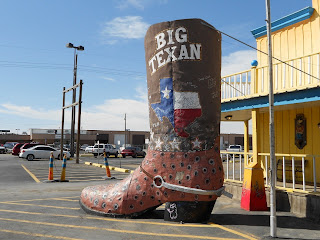 |
| The Big Texan, Amarillo Texas |
Another unique stop on your west Texas road trip is the
American Quarter Horse Heritage Center and Museum located on the north side of Interstate 40 just west of the S. Grand St. exit. The American Quarter Horse Association is also located in an adjacent office building. Lots of great information on famous Quarter Horses and terrific artwork both inside and outside the museum building.
One more unique stop, and there are several others in Amarillo, is the
English Field Air and Space Museum. The museum is located east of Amarillo. Directions to get there..turn to the north from Interstate 40 onto Lakeside Rd. (Loop 335) and then drive
north for two miles. Make a right hand turn onto U.S. Highway 60 and drive two miles
east. One thing you'll be able to view at this excellent museum is the only
Mars Lander vehicle on earth.
(Photos are from author's private collection)


